
What determines the rule?
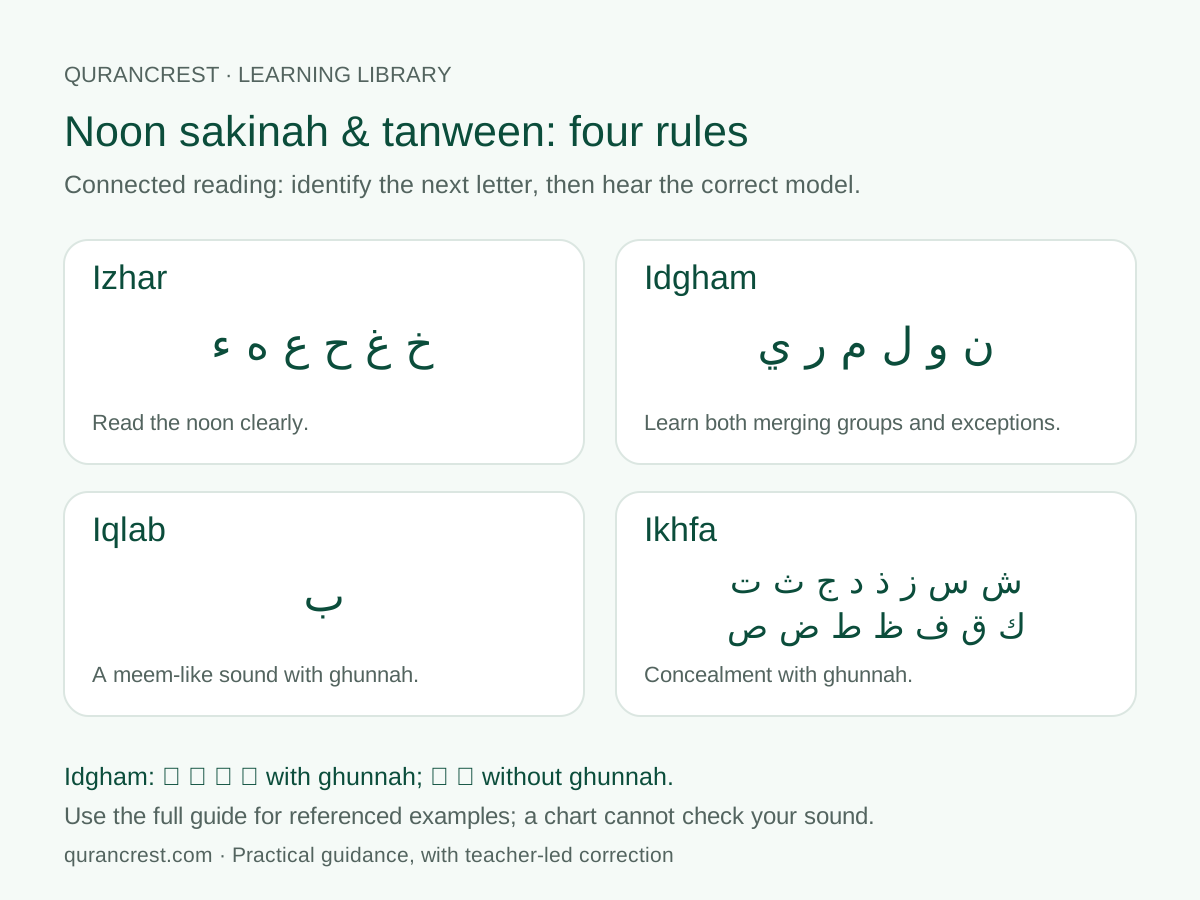
Find noon sakinah or tanween, then look at the following letter while continuing recitation. That letter helps identify Izhar, Idgham, Iqlab or Ikhfa. Naming the rule is the recognition task; learning its sound requires a correct model and feedback.
Recognize the starting sign
Noon sakinah is a noon without a vowel. Tanween marks indicate an added n-sound at a noun’s end when continuing. Do not apply a connected-reading example automatically when stopping. The About Tajweed introduction explains this distinction.
| Rule | Following letters | Basic listening focus |
|---|---|---|
| Izhar | ء ه ع ح غ خ | Pronounce the noon clearly. |
| Idgham | ي ر م ل و ن | Merge in the relevant connected-word setting. |
| Iqlab | ب | Change the noon sound toward meem with ghunnah. |
| Ikhfa | ت ث ج د ذ ز س ش ص ض ط ظ ف ق ك | Conceal the noon with ghunnah; hear the teacher’s model. |
Separate the two Idgham groups
The letters ي ن م و belong to the ghunnah group; ل ر are the group without ghunnah. Apply this introductory chart with a teacher, including same-word exceptions. Do not invent an extra vowel between words to make a pattern easier to say. See the merging lesson.
Use examples in their verse context
| Rule | Short excerpt / location | What to notice |
|---|---|---|
| Izhar | Surah Abasa 80:18; see the clarity lesson. | Noon before hamzah. |
| Idgham | هُدًى مِّن — 2:5 | Tanween followed by meem across words. |
| Iqlab | مِن بَعْدِ — 2:27 | Noon followed by ba. |
| Ikhfa | مِن شَرِّ — 113:2 | Noon followed by sheen. |
Excerpts use simplified Arabic typography rather than reproduce every Mushaf annotation. Open the full verse and an appropriate recitation. A chart cannot demonstrate the exact tongue position or ghunnah timing; follow a qualified teacher’s model.
Practise recognition before mixing every rule
- Select one teacher-assigned example.
- Point to the noon or tanween and the following letter.
- Name the rule before listening.
- Listen and repeat the phrase, then read it in context.
- Ask whether the sound and timing, not just the name, are correct.
If the learner cannot identify the letters reliably, review that foundation rather than memorize a large rule chart. If the names are secure but the sound is inconsistent, keep the task small enough for live correction.
Common traps to discuss
Stopping between words changes the exercise. A voweled noon is not noon sakinah. Idgham has exceptions that a beginner chart does not fully explain. For Iqlab and Ikhfa, do not determine mouth position from English transliteration alone. The linked Iqlab and Ikhfa lessons provide more detail.
Frequently asked questions
Can I master these rules from a table?
A table supports recognition. Accurate application also needs a recitation model and correction.
Does the same rule chart explain stopping?
No. These introductory examples concern connected reading. Learn stopping separately with the teacher.