
What is Madd?
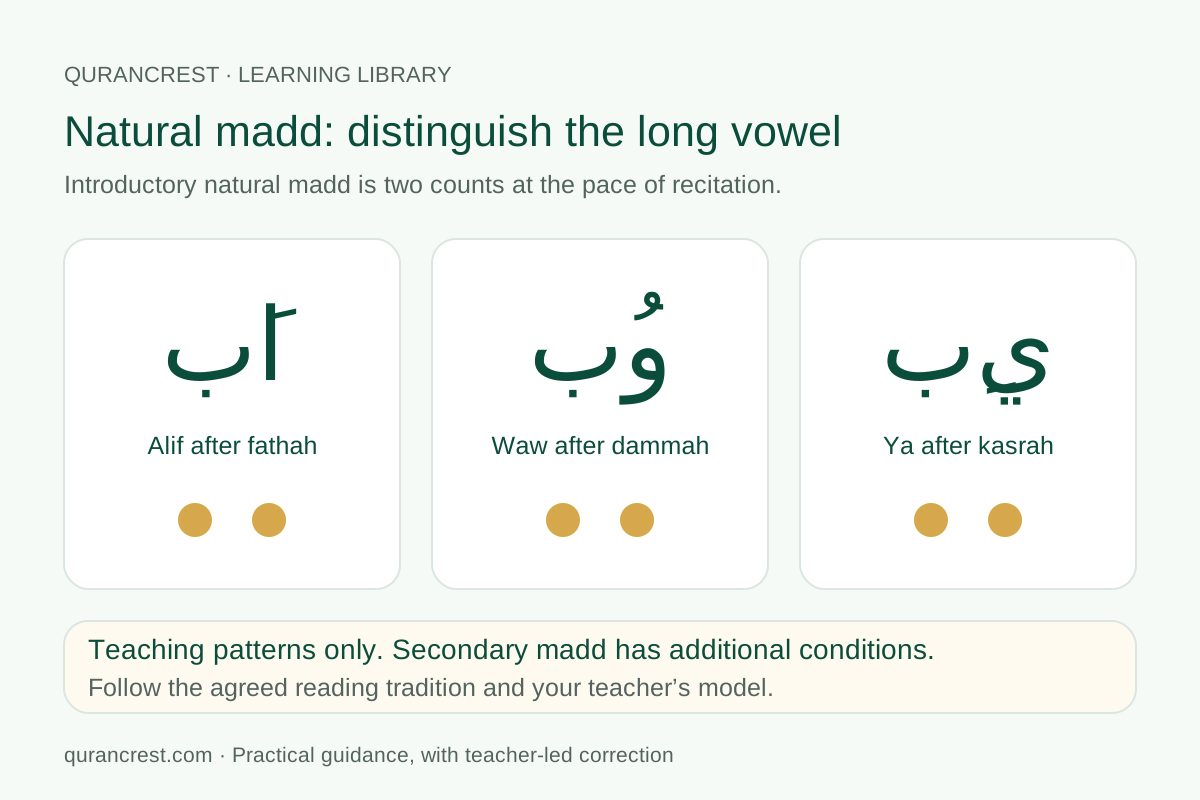
Madd concerns lengthening a vowel sound in recitation. A beginner should recognize the long-vowel setting, distinguish it from a short vowel and practise a consistent model. Natural madd is commonly taught as two counts; other madd categories must be learned with their conditions and the recitation approach being followed.
Look at the letter and the preceding vowel
| Letter | Preceding vowel | Practice pattern |
|---|---|---|
| Alif | Fathah | بَا |
| Waw sakin | Dammah | بُو |
| Ya sakin | Kasrah | بِي |
These are teaching patterns, not quoted Quran verses. A waw or ya is not automatically a madd letter in every setting. Identify the preceding vowel and the actual function of the letter before deciding how to read it.
Understand natural madd
In the basic natural-madd setting, the long vowel is not being extended because of a following hamzah or sukoon. The Quran Academy natural-madd lesson introduces the two-count length and examples such as قَالَ, يَقُولُ and قِيلَ. Ask your tutor to model each one before trying it inside an assigned passage.
What does a count mean in practice?
A count relates to the pace of recitation; it is not a universal stopwatch duration. Listen to how the teacher maintains the length while keeping the surrounding reading steady. Tapping can be a temporary learning aid if the tutor recommends it, but it should not force the phrase into an unnatural rhythm.
Why this guide does not give one length for every Madd
Secondary madd involves additional conditions. A hamzah, an original sukoon or a stopping-related sukoon can affect the category. Counts and permitted choices need to be understood within the reading tradition and transmission being studied. Do not combine the longest option from one recording with another option from a different lesson simply because both are online.
| Check | Ask yourself | Next step |
|---|---|---|
| The long vowel | Does this letter match the preceding vowel? | Identify the exact location with the tutor. |
| Continuation | What follows while continuing? | Ask whether a secondary reason is present. |
| Stopping | Does stopping change the final sound? | Learn the stopping version separately. |
| Consistency | Which approach is my teacher using? | Keep the agreed model consistent across practice. |
A focused practice task
- Choose a short passage from the tutor, not an entire new surah.
- Find one natural-madd example and read the surrounding phrase.
- Listen to the model and compare your short and long vowels.
- Repeat without speeding up at the difficult word.
- Ask the teacher to check whether the length stays consistent.
Watch for two different mistakes
A learner may shorten a genuine long vowel, or stretch a short vowel because the word feels difficult. Both need a specific correction. Write down the exact exercise and whether the task is recognizing the pattern or applying its length. Avoid a vague note that says only “Madd needs improvement.”
Frequently asked questions
Is every alif, waw or ya read as Madd?
No. The written setting and preceding vowel matter. A teacher can identify the relevant pattern.
Are all Madd sounds two counts?
No. Two counts is the introductory natural-Madd length. Secondary categories require their own conditions and agreed recitation method.
Is a written guide enough to judge my sound?
It supports understanding, but a qualified listener needs to check how you actually recite.