
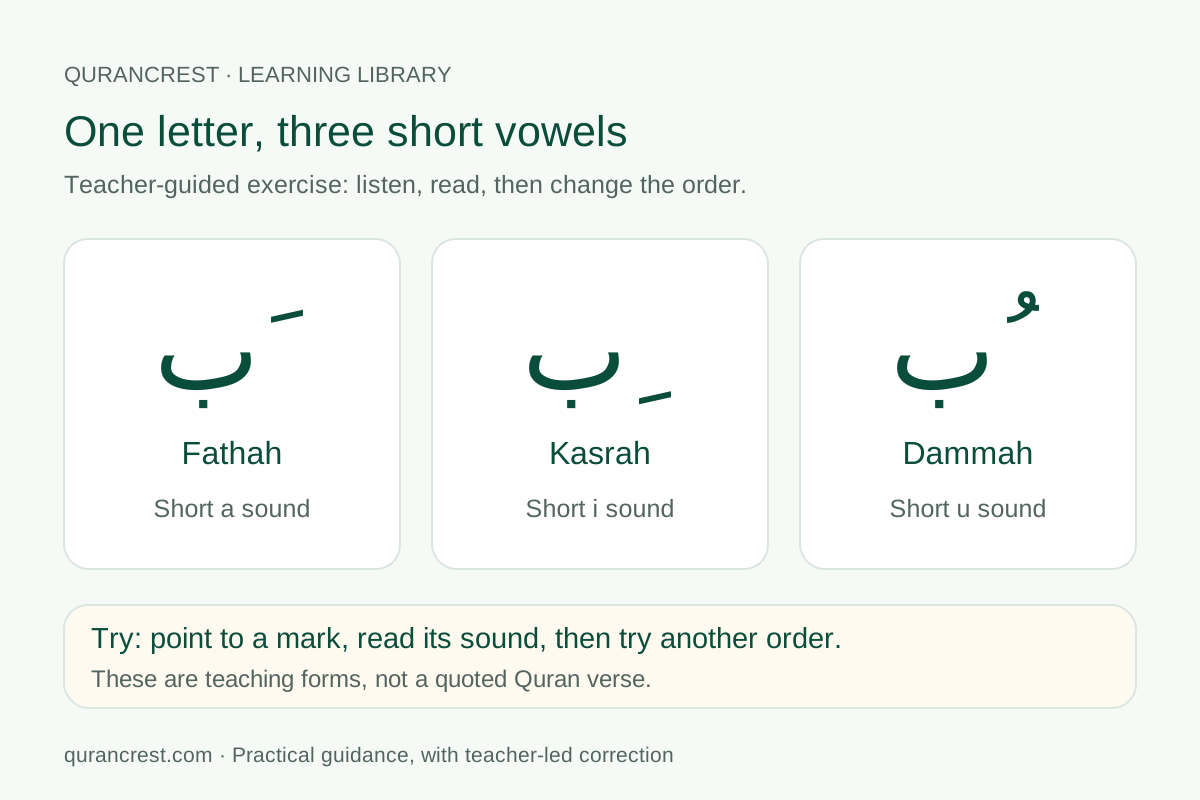
A useful beginner lesson checks whether the learner recognizes a letter, hears its sound and reads the same pattern independently. The following example uses one letter so the vowel, rather than a changing letter shape, becomes the focus. The tutor may choose a different starting exercise after listening.
These are ba with fathah, kasrah and dammah. Listen to the tutor's model, read each sound aloud, then try them in a different order. Transliteration can support an explanation, but the teacher needs to hear the Arabic sound.
What a tutor can check in a short exercise
| Task | What to observe | Useful next step |
|---|---|---|
| Recognize the letter | Find the same letter among other letters without guessing. | Review a small set of commonly confused shapes. |
| Read the vowel | Respond to the vowel mark rather than memorizing the order. | Mix the three marks in a short exercise. |
| Read a joined form | Recognize the letter within a suitable joined exercise. | Practise the specific form that caused difficulty. |
When selected review is enough
A returning learner does not automatically need to restart the entire Qaida. If individual letters are secure but joining is weak, ask for focused joining practice. If a learner reads familiar pages from memory, an unfamiliar short exercise helps separate recall from reading.
A sensible move into Quran reading
The next step is guided reading when the learner can approach joined patterns and common marks with reasonable independence. It is a teacher-led decision based on reading, not an automatic promotion after a particular number of weeks.